For product teams

Every meeting, deck and Slack thread becomes an objective your delivery team can act on.

You own the messiest input in the company. Planwright turns it into objectives with acceptance criteria that coding agents claim and finish — and gives you a roadmap and a value/risk matrix that stay current because the work updates them, not a status meeting.

A forty-minute planning call, and what comes out of it

Brightline Logistics is invented, and so is everyone in this transcript. The shape of it will not be.

Input — meeting transcript

Weekly delivery sync · 12 Nov

Dana (VP Ops)

The carrier complaints are all the same thing. They get a load tendered, then nobody tells them the dock time changed.

Marcus (Head of Product)

Is that the notification gap, or is it that dock times live in the warehouse system and we never read them?

Dana

Both. And the two big shippers have asked for SSO before they'll expand — that's a renewal conversation in January.

Priya (Eng)

We can read dock times today. Pushing changes out to carriers is new work. Different sizes.

Marcus

Then let's not pretend it's one ticket. Alerts first — that's the complaint. SSO has a date on it, so it can't drift.

Output — objectives, drafted for your edit

One call, two objectives — because it was two pieces of work

Carriers are told when a dock appointment moves

P1

Intent: Cut the repeat carrier complaint — a changed dock time currently reaches nobody outside the warehouse system.

Acceptance criteria

  • A dock time change in the warehouse feed sends the assigned carrier a notification within 5 minutes
  • The notification states the old time, the new time and the load reference
  • Carriers can see the current dock time without signing in to the shipper portal
  • No notification is sent when the change originated from the carrier's own reschedule

Initiative: Shipment Visibility
SSO for enterprise shippers

P1

Intent: Unblock the January renewal conversation with the two accounts that made SSO a condition of expanding.

Acceptance criteria

  • SAML 2.0 sign-in works against Okta and Entra ID
  • An admin can require SSO for everyone in their shipper organisation
  • Existing password accounts migrate on next sign-in without losing history
  • SSO configuration is covered by the audit record, like every other admin change

Initiative: Enterprise Readiness

Nothing is scheduled yet. Drafting is where the ambiguity gets named — the part a coding agent cannot do for you, and the part that decides whether it can do the rest.

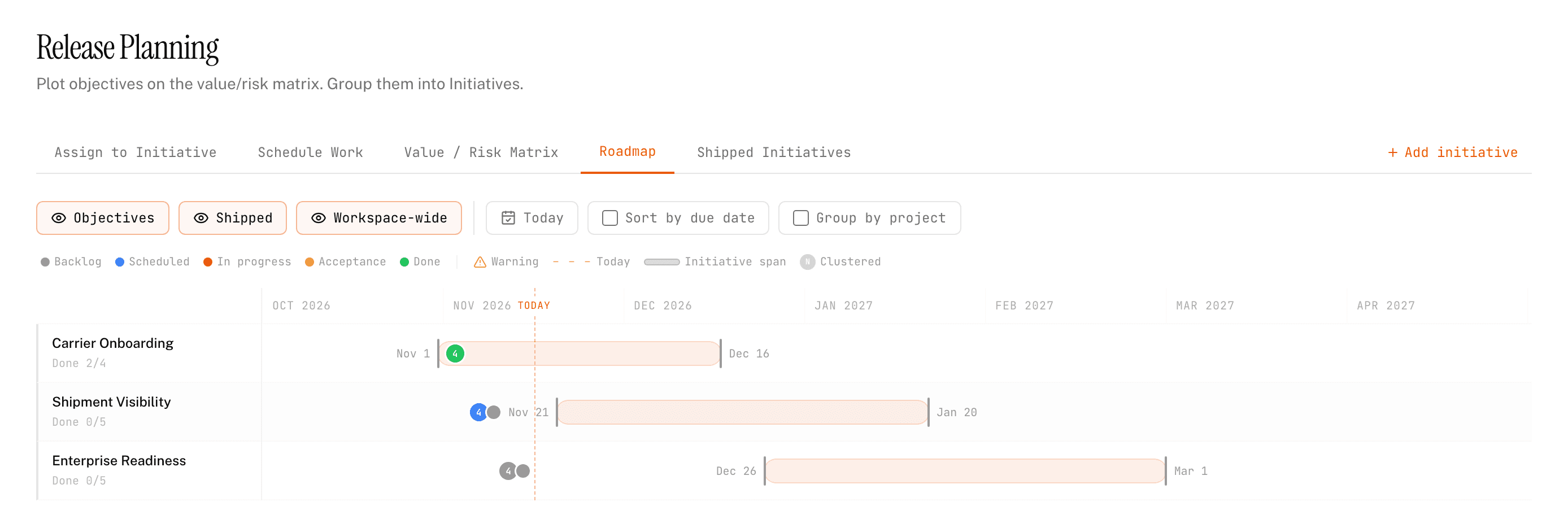
A roadmap that is a read, not a ritual

Initiatives span the dates you set; the objectives inside them move as agents claim, finish and get accepted. Nobody updates this before the meeting, because the only way to change it is to do the work.

The Planwright roadmap: three initiatives spanning November to March, each showing how many of its objectives are done.

Scroll sideways to read across →

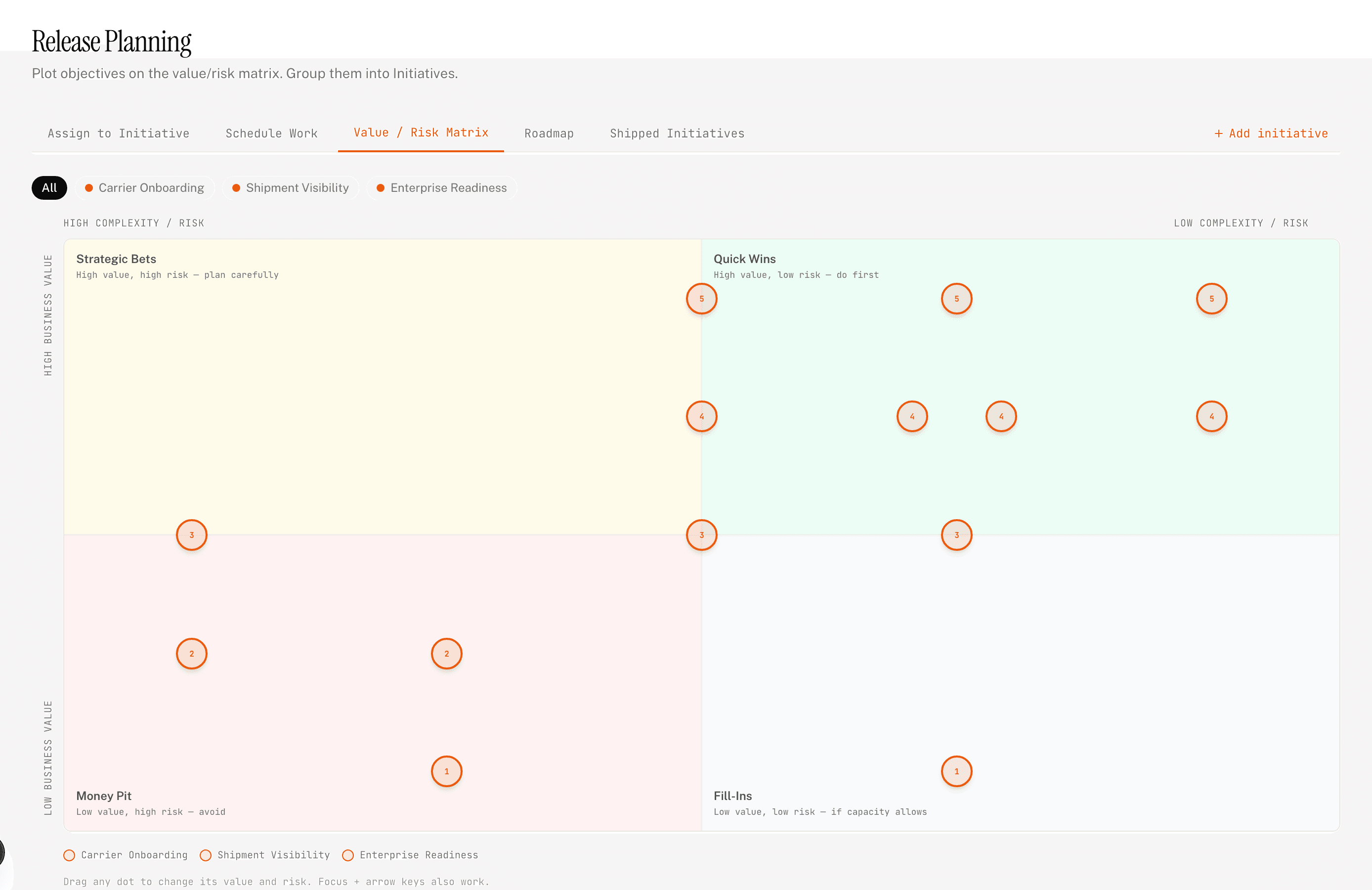
Decide what is worth it before you schedule it

Every objective gets placed by business value and complexity/risk. Quick wins and money pits stop being an argument and start being a position on a grid — and the placement happens before anything is scheduled, which is the only time it changes a decision.

The Planwright value/risk matrix: objectives plotted across four quadrants — strategic bets, quick wins, money pits and fill-ins.

Scroll sideways to read across →

Governance

Every acceptance is a signed record, not a status change

When you accept an objective, that decision is appended to a hash-chained ledger and signed — who accepted it, against which criteria, at what time, on which commit. It cannot be edited afterwards, including by us. When someone asks who approved AI-written code, the answer is a record rather than a recollection.

How the audit chain works →

Questions product leaders actually ask

We already run Jira. Does this replace it?
No. Keep Jira for everything it is good at. Planwright owns the layer your coding agents read from and write back to — objectives with acceptance criteria, and a signed record of what was accepted. Teams typically run both for a while and let the overlap settle on its own rather than migrating up front.
Which inputs can it work from?
Anything you can paste or point an agent at: meeting transcripts, email threads, Slack exports, a deck's speaker notes, a requirements doc. There is no connector to install for this — you or your agent brings the text in, and the drafting happens against it.
Does a product manager need to write the acceptance criteria?
They get drafted for you and then you edit them. That is the point of the step: the criteria are where a vague request becomes something an agent can finish and a human can check, and the person who knows whether they are right is the one who sat in the meeting.
What does it cost for a product team?
Business is $39/seat/mo, which is the plan with the roadmap, the value/risk matrix and workspace-wide planning across projects. Free covers a single user if you want to try the drafting flow before involving anyone else.
Our engineers do not use coding agents yet.
Then this is early for you, and we would rather say so. Planwright is worth money once agents are doing a meaningful share of the work; before that it is a well-structured backlog you are paying for.